
2025 February Newsletter 
Editor's Report
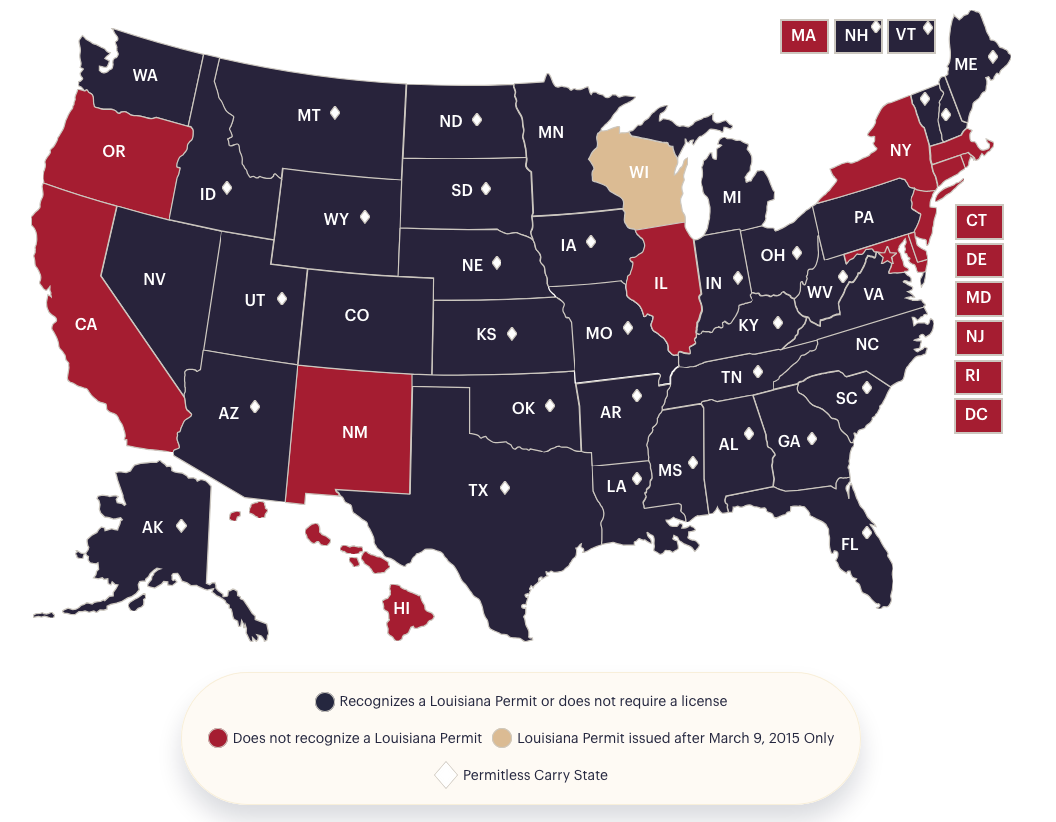
Would You Like to Carry Concealed in California?
The map shown above the banner of this article was borrowed from our friends at US LawShield (if you don't have carry insurance, you NEED it). The map depicts the states where a Louisiana Concealed Carry Permit holder can, and cannot legally carry a firearm with reciprocity. Note that California is bright RED.
However, a district court has ruled that members of the Second Amendment Foundation (SAF) nationwide can soon apply for a non-resident carry permit in California.
The United States District Court for the Central District of California issued a preliminary injunction in CRPA v. LASD, SAF’s legal challenge to the refusal of California officials to allow non-resident carry permits in the state.
“The judge ruled that as a SAF member your right to carry a firearm for self-defense doesn’t stop at the California border just because you are a resident of another state,” said SAF founder and Executive Vice President Alan M. Gottlieb. “This is just one more benefit of being a SAF member.”
The injunction requires California to accept permit applications from any United States resident outside the state who is a member of SAF or its partner organizations and not prohibited from possessing firearms. While the ruling was handed down January 23, 2025, the order will go into effect in 90 days.
SAF is joined in the case by the California Rifle & Pistol Association, Gun Owners of America, Gun Owners Foundation, Gun Owners of California, and several private citizens. The original complaint was filed in December, 2023, and followed by a motion for preliminary injunction shortly thereafter in January, 2024.
“It’s common sense that your fundamental right to bear arms does not evaporate when you leave your home state,” said SAF Director of Legal Operations Bill Sack. “We’re committed to dragging states like California kicking and screaming into alignment with the demands of the Constitution, and now, peaceable SAF members can exercise their right to bear arms in California.”
Stories from the Field

Can You Carry a Gun Across State Lines? Your Guide to Transporting Firearms
Packing the family into a car and driving to meet relatives, witness natural wonders or simply see new parts of the country is a wonderful way to spend time together and learn more about our nation.
One thing that can complicate such an adventure is figuring out how to carry firearms while still adhering to applicable laws as you cross state lines. Making sure the time, money and effort you put into training for concealed carry isn’t defeated by an accidental violation of the law is definitely worth the effort.
Let’s take a look at how one can safely, and legally, transport a firearm across state lines. It can be tricky, but with the right information and a good plan, gun owners traveling across state lines can do so safely and within the law.
While the difference between carrying a firearm and transporting a firearm may sound insignificant, the law finds it very significant. A firearm can be transported just about anywhere as long as it’s legal to own in both the point of departure and destination (with some qualifications surrounding where and for how long you might stop along the way).
However, if you’re carrying one on or about your person, there are additional legalities. “Transporting” a gun generally involves it being stored in such a way that it’s not immediately available to the driver. Commonly, this is interpreted as being in the trunk, stored separately from any ammunition, unloaded and in a locked container. For purposes of our conversation, “carrying” a gun should mean in a holster on your body, in a bag/purse or inside a vehicle so that it’s immediately available to you (in glove box, center console or a holster attached to the inside of the vehicle, for example).
If you’re transporting, you generally have less to worry about with regard to city, county and state laws. There’s a federal law protecting this activity (assuming you do so correctly, which we will cover later in this article. If you’re carrying, you’ll likely have to do more homework as well as ensure that you have a permit in the state, or they offer reciprocity for one of your concealed carry permits. Other considerations include permitless carry states, and whether you are allowed to carry inside or outside a vehicle. There are many factors that come into play when you’re carrying, so again, determine what your needs will be and seek relevant information accordingly.
Investigate what it takes to legally carry a gun in a vehicle in your home state. While it’s not always required to have a carry license or permit (especially if you intend to simply transport firearms, rather than carry them), in many states it’s the safest way to do so without raising questions about what constitutes legal carry in a vehicle. Even in states that don’t require a permit for carrying guns in a vehicle, or at all, it’s often beneficial to get a permit anyway—especially if you intend to transport firearms across state lines. Having a permit in relevant states can only make things easier.
Let’s assume you intend to carry a gun on or about your person across state lines. This puts you in the “carry” category. With that in mind, what are some concerns you should be aware of and address before and during your trip? To start with, consider the states you’ll be in and their relevant gun laws.
Concealed carry reciprocity should be a primary concern for any person looking to carry a firearm and stay legal while traveling state to state. Knowing which states honor your concealed carry permit, and which don’t, is key.
Once you know which states you’re going to and how their gun laws impact your carry, you can plan your trip to maximize the amount of time you can legally carry. Just remember that gun laws aren’t limited to the state. In fact, many gun laws are passed at county and municipal levels. This can create an extreme patchwork of laws which might translate into you being perfectly fine on one side of the street and then literally committing a crime on the other. So how do you find out?
First, determine if the state has a preemption law. Preemption requires that the state legislature writes all relevant laws (in this case, gun laws). Preemption doesn’t allow smaller governing bodies like cities or counties to go beyond that state law. If the state in question has preemption, you generally don’t have to worry about local laws being different. Once you have potential local laws down, it’s time to consider whether you’ll be visiting federal property, e.g., national parks, national forests, etc.
National parks aren’t of much concern for gun users looking to carry. If you’re allowed to carry the gun in the state the park is in, you’re generally fine doing so in the park itself, by virtue of federal law 50 CFR § 27.42. However, there may be buildings operated by the federal government, like U.S. Postal Service offices, which don’t allow possession of a firearm on the premises. Ranger stations, visitors’ centers and even gift shops might fall under this designation. Please be aware that this might be an issue and remember to safely and securely disarm as needed.
National forests are similar, though some states do have regulations that affect legal carry. Be sure to consult your resources before visiting them while armed. Federal buildings within national forests are something to watch out for as well, just like for national parks.
Native American reservations and lands aren’t considered U.S. territory, and they may have their own laws and regulations that are entirely different from the states they exist within. Even if you have a permit to carry in that state, the reservation may choose not to recognize it on its territory. You should also be aware that if you exit a highway (governed by federal and state laws) onto reservation land, you’ll be under the reservation’s jurisdiction.
We’ve now navigated a not-always simple network of state and local laws, contemplated state preemption, considered the risk of entering federal buildings in national forests as well as reservations. If your goal is to exercise your constitutional right to carry a firearm in a safe, legal manner, it’s important to be aware of these things.
If, in your upcoming journey, you find yourself looking at the transportation of a firearm across a more restrictive state, there are ways to do so legally. This is known as the “Safe Passage” provision of the Firearm Owners Protection Act (FOPA) found in 18 U.S.C. § 926A and elaborated upon in our previously referenced travel guides.
Now that you know the ins and outs of traveling with firearms, we recommend getting a U.S. LawShield travel guide for your state as well as any states you might be visiting. After all, as the adage goes, “Forewarned is forearmed.”
Concealed carry on Federal property? Here is what you need to know…
If you have a license or permit to carry a handgun issued by your home state, the license or permit does not give you any rights to carry onto federal property or inside federal facilities. One difference between federal law and state carry law is how the terms property, premises, buildings, and facilities are used. Under federal law, a person is generally prohibited from carrying on federal property (think grounds, parking lots, and sidewalks) and at federal facilities (think buildings).
Carrying at Veterans Affairs Hospitals and Post Offices
The major places we see good people get into trouble are Veterans Affairs hospitals and the United States Post Offices. As you may know, you are generally prohibited from carrying a firearm into one of these facilities, but did you know that prohibition extends to the parking lot? Even a firearm inside of your vehicle at these locations is almost always a violation of the law.
Carrying at National Parks
National parks are a little bit different. Generally, federal law allows the possession of a firearm in a national park, so long as you are not prohibited from possessing a firearm and the possession is done in compliance with the law in the state in which the national park is located. However, just like the other federal facilities we’ve discussed, you cannot bring a firearm into any federal buildings—including: ranger stations, museums, exhibits, and restrooms.
Consent to Search
You’re driving home after a long day of work, and a police officer stops you for speeding. He pulls out his ticket book and he asks if there’s anything in the car he should know about. Perplexed, you say no. The officer hands you a ticket and then asks if he can take a look in your car. Do you have to let him into your car? No. Thanks to the Fourth Amendment to the United States Constitution.
Court battles have eroded the Fourth Amendment to the point where more searches today are performed by law enforcement without a warrant than with one. These exceptions to the warrant requirement are numerous and nuanced.
But, to start us off, we have to begin with the Fourth Amendment that reads: “The right of the people to be secure in their persons, houses, papers, and effects against unreasonable searches and seizures shall not be violated. And no warrants shall issue, but upon probable cause supported by oath, or affirmation, and particularly describing the place to be searched and the persons or things to be seized.”
What is a search? A search is a government agent’s intrusion into a person’s reasonable expectation of privacy. The Fourth Amendment provides that the police must obtain a warrant based on probable cause to interrupt this right lawfully, but if a police officer asks to search your person, your vehicle, or home, and you say yes, he isn’t required to obtain probable cause or a warrant. You have provided consent, and this is the most frequently cited exception to the warrant requirement.
So, what if you find yourself resting comfortably in bed at 2 AM and you hear a loud knock at the front door, and an authoritative voice calls out, “Police; open up”? Do you have to let them in? If they don’t possess a valid warrant, then no. If they claim to have a valid warrant, they will likely force entry into your home if you refuse them entry. In some cases, they don’t even have to knock and announce.
When it comes to a vehicle, most good folks would think they have nothing to hide and allow the police to search it. There are perils to this. You waive any argument that any evidence was gathered illegally. For example, if you keep your prescription thyroid medication in a pill divider and not the original prescription bottle, you could be arrested immediately. It’s always good practice to refuse consent to the search of your home or your car because you never know what the police may find and use against you.
If you do refuse consent, do so politely. Police officers will generally be annoyed by a person who doesn’t permit them to search. The good news is that it’s not against the law. If they want to search your car or your home and they don’t have an exception, they’re required to get a warrant.
Eyes on the Anti-Gunners

The ATF Needs to be Reined in and Reformed
In the December issue of the LSA Monthly we told you about the botched raid by the ATF of the home of the law-abiding Manley family. That raid involved an early morning search warrant by more than a dozen heavily armed ATF agents who lobbed two flashbang grenades into the family's home.
Manley’s search warrant was most likely caused by someone outside of the family arrested by ATF, who told the agents he had a lot of guns, which is true. Manley estimated he owns more than 70 firearms, but all of them comply with Maryland and federal laws. He owns no full-auto firearms, suppressors or destructive devices. The ATF learned this after threatening to blow open Manley’s gun safe, which he opened for the agents, who found nothing illegal.
The ATF’s flawed tipster must have also told agents that Manley was a convicted felon, who cannot lawfully possess firearms. Manley, while cuffed, told agents he had no felony record, which they quickly confirmed.
The ATF has a lengthy history of botched raids.
In March, ATF agents shot and killed Bryan Malinowski, executive director of the Clinton National Airport in Little Rock, Arkansas, in his home.
Agents were clearly spoiling for a gunfight when they went in during early morning hours, and they got one.
ATF has yet to comment officially on the March 19 killing, other to claim Malinowski fired first. But Malinowski’s family released a statement, which confirms what everyone already knew: It is extremely unlikely that the 53-year-old airport executive director knew he was trading gunfire with federal agents. It is far more likely Malinowski believed he was defending himself and his wife from armed home invaders.
“Bryan Malinowski was asleep but rose to the sound of the door crashing and located a firearm. His wife believed the noise must have been intruders and she fully believes her husband thought the same. He loaded a magazine into a pistol and emerged from the master bedroom into a hallway leading indirectly to the front entryway. He reached a corner in the hall and looked around it to see several unidentifiable figures already several steps inside his home,” Malinowski’s family said in the statement. “We do not know who shot first but it appears that Bryan shot approximately three times at a decidedly low angle, probably at the feet of the intruders who were roughly 30 feet away.”
Malinowski is not alone. Months earlier, ATF agents raided the Tuskahoma, Oklahoma home of Russell Fincher, who worked as a high school history teacher, a Baptist minister and a parttime gun dealer, just to make ends meet.
Fincher had a Federal Firearm License for three years, but he had no brick-and-mortar gun shop. He was what used to be called a “kitchen table FFL.” He sold most of his firearms at gun shows, including Wanenmacher’s Arms Show in Tulsa.
On June 16, 2023, Fincher and his son were packing for a gun show in Tulsa when the phone rang. It was the ATF. They said they wanted to talk to him before he left for the gun show. Seven vehicles roared up to his home and disgorged a dozen ATF agents wearing tactical gear, armed with AR-15s.
“They called me out onto my deck and handcuffed me. My son was there and saw the whole thing. He’s 13 years old,” Fincher said. “They held me on the porch for about an hour. I was surrounded by agents. One by one, they yelled at me about what I was doing. In my mind I decided if they were going to beat me up over every little thing, I’m done. As soon as I said, ‘If you want my FFL, you can have it,’ one of the agents pulled out a piece of paper and said, ‘Well then sign here.’ He had made three copies in case I screwed one up. It was exactly what they wanted. I was shocked.”
As soon as Fincher relinquished his Federal Firearm License, the ATF began loading up his guns.
“I asked them why, and they said they were ‘evidence.’ I’d estimate they took $50,000 to $60,000 worth of guns,” Fincher said at the time.
ATF’s own history shows a complete disdain for the sanctity of human life. In addition to the scores of lives lost at Waco, a Deputy U.S. Marshal and Randy Weaver’s wife and son were killed during ATF’s Ruby Ridge fiasco. Their “Fast and Furious” scheme resulted in the death of Border Patrol Agent Brian Terry and hundreds of Mexican nationals, who were killed by the weapons ATF allowed to walk straight into the hands of the Mexican drug cartels.
Both David Koresh and Randy Weaver visited nearby towns frequently, as did Manley, Malinowski and Fincher.
A local police officer or deputy sheriff could have easily and safely arrested any of the men without incident, but when the ATF gears up and dons its tactical blinders, they lose sight of simpler and safer enforcement options.
While there are dozens of federal agencies likely to receive attention from President Donald Trump after he takes office in around three weeks, the ATF is different. Quite simply, they don’t know what they’re doing, but they have access to the same types of weapons and tactical gear other federal agencies use when they conduct raids and search warrants. As a result, even law-abiding Americans should fear the ATF.
The training course for ATF’s Special Response Team is only two weeks long. Their poorly trained ‘operators’ are a threat to public safety, but they’re better trained than the agents who routinely kick doors and toss flashbangs like they’re cool.
Given their poor training and complete lack of professional leadership, if they’re allowed to continue their raids, it is only a matter of time before an ATF agent kills another innocent American in their home.
President Trump should keep this in mind when he decides what to do about his most lethal but most poorly trained and horribly led federal law enforcement agency, the ATF.
Legislative Update

Lara v. Evanchick may have Implications for a Case filed by the LSA and others in Louisiana
The Second Amendment Foundation, Firearms Policy Coalition and three private citizens, including Lara, for whom the case is named, won a victory for young adults in Pennsylvania, where a panel of the Third U.S. Circuit Court of Appeals ruled 2-1 to remand the case back to the District Court with instructions to enter an injunction forbidding the state police from arresting law-abiding 18-20-year-olds for openly carrying firearms during a declared state of emergency. The case is known as Madison Lara v. Commissioner Pennsylvania State Police.
It is the second time the Third Circuit has ruled in SAF’s favor on this case. After the initial ruling, the state appealed to the U.S. Supreme Court, which, in turn, remanded the case back to the Third Circuit to reconsider in light of the high court’s recent ruling in Rahimi. The Third Circuit determined that Rahimi changed nothing about their analysis and once again ruled for the plaintiffs. The circuit court then ordered the District Court to enter an injunction in the plaintiffs' favor.
Writing for the majority, Circuit Judge Kent A. Jordan, a George W. Bush appointee, noted, “It is undisputed that 18-to-20-year-olds are among ‘the people’ for other constitutional rights such as the right to vote, freedom of speech, the freedom to peaceably assemble and to petition the and the right against unreasonable searches and seizures. We therefore reiterate our holding that 18-to-20-yearolds are, like other subsets of the American public, presumptively among ‘the people’ to whom Second Amendment rights extend.” Judge Jordan was joined by Judge D. Brooks Smith, another Bush appointee. Judge L. Felipe Restrepo, a Barack Obama appointee, dissented.
So, why might this case affect young adults in Louisiana? The SAF, Louisiana Shooting Association, Firearms Policy Coalition and two private citizens, Emily Naquin and Caleb Reese have filed a suit in the US District Court for the Western District of Louisiana challenging the federal ban on handgun purchases from FFLs by those who are between the ages of 18 and 21. The lawsuit asks a federal court to declare the handgun purchase ban unconstitutional as it infringes upon the Second Amendment and enjoin the Defendants from enforcing the ban.
The lawyers for Reese et al. have argued that the government's arguments in the Louisiana case fail for the same reason that they failed in the Pennsylvania case. We will update you as more information becomes available.
UPDATE
On January 30 the LSA scored an important victory in its challenge of a federal prohibition on handgun sales to young adults with a unanimous ruling by a three-judge panel of the Fifth U.S. Circuit Court of Appeals to reverse a lower court decision and remand the case back for further action.
LSA is joined in the case by the Second Amendment Foundation, the Firearms Policy Coalition, and two private citizens, Emily Naquin and Caleb Reese, for whom the case is named. The case is known as Reese v. ATF.
Writing for the court, Circuit Judge Edith Hollan Jones, a Ronald Reagan appointee, stated, “Ultimately, the text of the Second Amendment includes eighteen-to-twenty-year-old individuals among ‘the people’ whose right to keep and bear arms is protected. The federal government has presented scant evidence that eighteen-to-twenty-year-olds’ firearm rights during the founding-era were restricted in a similar manner to the contemporary federal handgun purchase ban, and its 19th century evidence ‘cannot provide much insight into the meaning of the Second Amendment when it contradicts earlier evidence.’ In sum, 18 U.S.C. §§ 992(b)(1), (c)(1) and their attendant regulations are unconstitutional in light of our Nation’s historic tradition of firearm regulation. We REVERSE the district court’s judgment and REMAND for further proceedings consistent with this opinion.”

The Constitutional Concealed Carry Reciprocity Act
On January 8, 2025, Representative Richard Hudson (R-NC) led hundreds of colleagues in introducing the Constitutional Concealed Carry Reciprocity Act (H.R. 38), aiming to establish nationwide reciprocity for concealed carry permit holders. This legislation would allow individuals with valid concealed carry permits to legally carry concealed handguns across state lines. The bill has garnered support from over 150 cosponsors, and President Trump has stated this legislation is one of his agenda items for 2025. Check out the US LawShield Gun Law Database for current reciprocity maps showing the states where your concealed carry permit is valid.
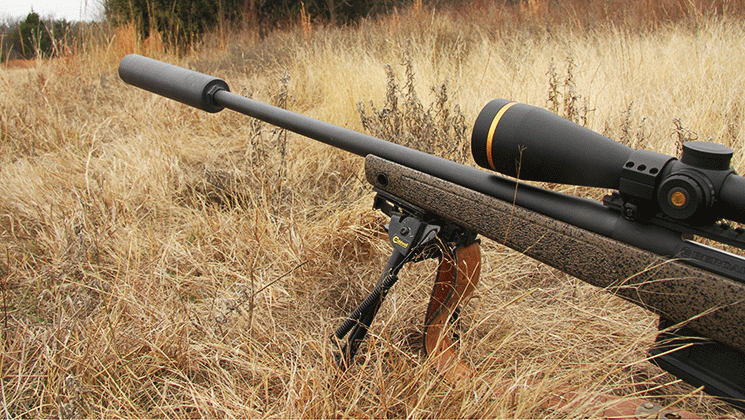
Hearing Protection Act – What You Need to Know
On January 14, 2025, Congressman Ben Cline (R-VA) reintroduced the Hearing Protection Act (H.R. 404), aiming to remove firearm suppressors (legally defined as “mufflers” or “silencers”) from the National Firearms Act’s purview. This legislative change would eliminate the $200 transfer tax and the lengthy approval process, allowing suppressors to be purchased through the standard National Instant Criminal Background Check System, similar to how standard Title I firearms like shotguns, rifles, and handguns are purchased.
News from the LSA

Annual Meeting of Members and Elections
Each year, the Louisiana Shooting Association holds its Annual Meeting of Members and the Election of one-third of the Board of Directors. This year's meeting will be held on Sunday, February 16, 2025 for 10:00 AM to 1:00 PM at Cabela's, 2200 W Cabela's Pkwy, Gonzales, LA 70737.
The current Board is composed of:
President: Daniel E. Zelenka, II (2025)
Vice-President: Everett Baudean (2025)
Secretary: Dwayne Vidrine (2027)
Treasurer: Jay D. Hunt, III (2027)
Director-at-Large: Barret Kendrick (2025)
Directors:
Paul Angrisano (2025)
Michael Burke (2027)
James Davis (2027)
Ron Duplessis (2027)
Clifford Grout (2026)
John K. Laws, III (2025)
Joseph “Jay” Meynier (2026)
John Overton (2026)
George Petras (2026)
Dave Ramey (2026)
Alternate Director
1st Alternate: Bruce A. Lemmert (2025)
At the meeting, those Directors whose terms expire in 2025 will be up for re-election. There will be five Directors elected for three-year terms. We will also elect two Alternate Directors whose terms will be for one year. [Note, we currently have one Alternate Director resulting from the death of Buck Kliebert.]
Once the 2025 Board is seated, the Directors will elect from among the Directors the Officers of the Corporation who will serve for a one-year term.
If you are interested in serving on the Board and have been a member of the LSA (in good standing) for at least two years, please contact Dwayne Vidrine.
Garand Raffle for Junior Shooters

Get your 2025 M1 Garand Raffle Tickets!
Tickets for the 2025 M1 Garand Raffle to Support Junior Shooting programs in the State are now available. The drawing will be held October 18, 2025. Winner need not be present to win.
All donations stay here in Louisiana and are spent solely on Junior Shooting programs.
Future Events
The LSA maintains a calendar of events that may be of interest to gun owners, shooting competitors, and friends of the Second Amendment. To see a list of events, visit our Meeting/Events Information page.
Join, Renew, or Donate
As you are no doubt aware, the LSA has a new enterprise system for maintaining our membership files and records. If you are confused on how to join or renew, follow this simple checklist below.
- If you are a current member (or a member who has expired for less than 30 days), you can renew your membership here. You will log into your account and pay your dues.
- If your membership has lapsed by more than 30 days, you cannot log into the members areas to pay your dues. You must go through the same process as someone who is joining the LSA for the first time. To do that, click here and fill out the form. This is inconvenient, but it is a security feature so that non-members do not have access to the members area of the website. Sorry.
- If you want to join the LSA for the first time, click here. An annual membership is only $15 and your support helps to protect your Second Amendment Rights here in Louisiana.
- If you wonder if your membership has lapsed or is current, try logging into your account here. If you can't log in, you have probably been moved to the non-member section. You can also shoot me an email and I can confirm your information for you.
If you would like to donate to the LSA, please click here.
If you would like to donate to the Junior Shooting Fund, please click here.
